The draft London Plan 2026 consultation
The Draft London Plan's Energy Targets Are Ambitious. We've Been Designing to Them for Years.
The Mayor's draft London Plan is out for consultation, and Chapter 5 changes how energy efficiency will be judged in new major development.The key energy policy, GHR1, is a meaningful shift, and for a good part of the industry it will take some adjustment.
We've been designing to these numbers for years, so it changes very little about how we work.
What GHR1 Energy Efficiency asks for
The draft plan drops the old approach of measuring performance as a percentage improvement over Building Regulations. That method never told you much about how a building would actually perform. In its place, GHR1 sets absolute energy targets a development has to meet and, importantly demonstrate in operation.
Under the policy, development would need to:
- Reduce demand first, through efficient form, fabric and services, rather than relying on offsetting or bolt-on technology.
- Meet minimum Energy Use Intensity (EUI) and Space Heating Demand (SHD) targets for major development, or report against benchmarks for other majors and refurbishments.
- Maximise on-site renewables: generating, storing and using energy on site.
- Meter, monitor and report actual in-use energy for at least five years after completion.
The proposed targets are set out below.
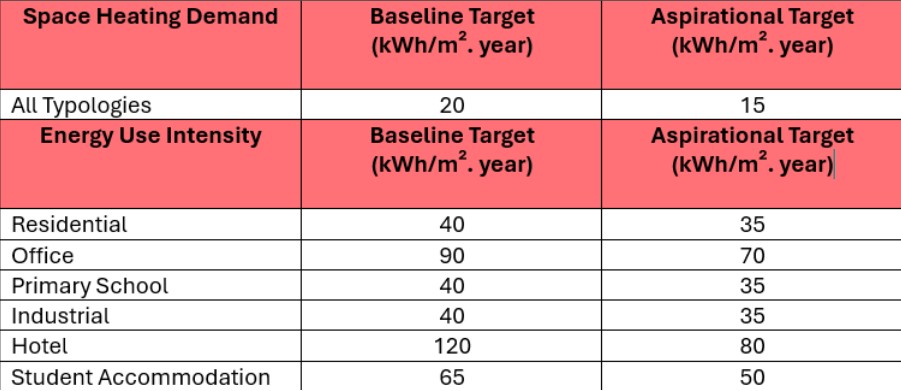
The last requirement is the one worth dwelling on. Reporting real, metered energy use for five years means a scheme can no longer be signed off on modelled figures alone. The building has to work in practice, not just in the assessment.
Impact on grid capacity
From an electrical perspective, GHR1 introduces another important requirement. Major developments must minimise not only annual energy consumption, but also peak regulated and unregulated energy demand.
EUI tells us how much energy a building is expected to use over a year. It does not tell us the maximum electrical demand that the local network or building infrastructure must support at any one time. A building could achieve a strong EUI while still creating a substantial peak through the coincidence of heating, cooling, hot-water production and other electrical loads.
As London continues to electrify, successful design will increasingly depend on understanding when energy is used, applying realistic diversity and using controls, storage and demand flexibility to manage peak loads. Reducing annual consumption remains essential, but reducing and reshaping maximum demand will be equally important to unlocking development where network capacity is constrained.
This must also be considered alongside the proposed MBUL4 utilities policy, which places greater emphasis on early engagement with electricity network operators, demand management, energy storage and aligning development phasing with network upgrades. Energy performance and electrical capacity can no longer be treated as separate conversations.
Why this is familiar territory for us
The targets in GHR1 sit squarely in Passivhaus territory. A space heating demand of 15 kWh/m².year is the long-standing Passivhaus limit, and it is the aspirational figure in the draft plan. The EUI targets line up closely with the LETI, UKNZCBS and RIBA 2030 benchmarks we already design to.
Hitting them is not about a single product or a clever piece of kit. It comes from getting the fundamentals right: a sensible form factor, a continuous and well-insulated thermal envelope, junctions properly resolved to control thermal bridging, good air tightness, and mechanical ventilation with heat recovery that is sized and commissioned correctly. We model all of this in PHPP from the outset, so the predicted performance rests on physics rather than optimistic assumptions.
Because we design for the way buildings actually behave, the five-year monitoring requirement holds no surprises. The gap between as-designed and as-built performance that catches out so many projects is something we plan out from the start, not something we hope to get away with.
The cost question
The assumption that this level of performance is expensive usually comes from projects that left it too late. Bolt efficiency onto a design that was never set up for it, or add renewables to compensate for a poor fabric, and it does cost money, and it rarely performs well.
We find the opposite is true when the building physics is embedded from Stage 0. Decisions about orientation, massing, glazing ratios and envelope strategy cost nothing to get right on the drawing board. Get them right early and the performance is built into the scheme, not paid for later as an expensive correction.
Sustainability is not a layer you add at the end. It is a design discipline, and the earlier it informs the work, the better and cheaper the outcome.
If you are planning a scheme in London
GHR1 is a clear signal of where London is heading, and it favours teams who design for measured performance from the first sketch. That is how we work as a matter of course.
We are currently preparing our response to the Draft London Plan. Our submission is being developed following a detailed review of the proposed policies and their potential implications. We intend to publish our full response and submit it before the consultation deadline of 5 October.
If you have a project coming forward, [get in touch] and we can help you meet, and better, the new energy targets from Stage 0.